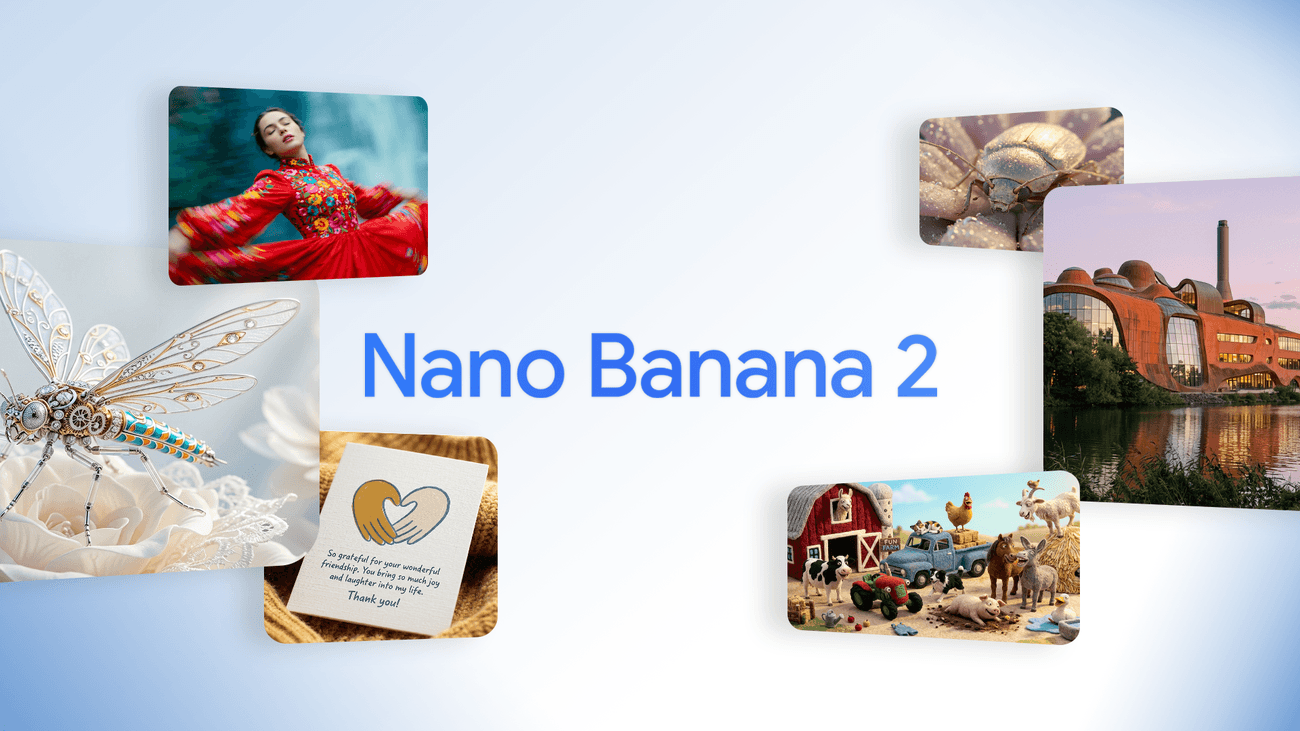
Google DeepMind has launched Nano Banana 2, an image generation model that the company says delivers pro-level capabilities at flash-tier speeds, targeting developers and production workflows that require both quality and low latency.
Editor's Note: This article is based on an official announcement from the source organization. Claims regarding performance, benchmarks, and capabilities have not been independently verified.
Image generation models have historically forced a trade-off: higher quality means slower inference, while faster models sacrifice fidelity and coherence. Nano Banana 2, according to Google DeepMind, is designed to collapse that trade-off — offering what the company describes as advanced world knowledge, subject consistency across generations, and production-ready specifications, all within a speed envelope comparable to its Flash family of models.
What Nano Banana 2 Actually Offers
The model's headline claims centre on three capabilities. First, advanced world knowledge — the model is said to draw on a broader understanding of real-world objects, contexts, and relationships when generating images, reducing the nonsensical outputs that plague faster, lighter models. Second, subject consistency, meaning the model maintains coherent visual identity for characters, objects, or scenes across multiple generated images — a critical requirement for production use cases such as advertising, game asset creation, and editorial illustration. Third, the model is described as production-ready, implying stability, reliability, and API availability suitable for integration into commercial pipelines.
Nano Banana 2 is designed to collapse the trade-off between quality and speed that has defined image generation for years.
DeepMind has not published a detailed technical paper alongside this release, so independent verification of these claims is not yet possible. The blog post frames Nano Banana 2 as a practical workhorse rather than a research showcase.
Speed as a Competitive Differentiator
The emphasis on flash-level speed is significant in context. Google's Gemini model family uses a tiered naming convention — Ultra, Pro, Flash, and Nano — where Flash and Nano tiers prioritise speed and cost-efficiency over raw capability. Achieving pro-level output at flash-level speed, if substantiated, would represent a meaningful engineering advance and a direct competitive move against image generation offerings from OpenAI, Stability AI, and Midjourney.
For developers building applications where image generation is a core feature — social platforms, e-commerce product visualisation, or real-time creative tools — inference speed directly affects user experience and infrastructure cost. A model that generates high-quality images faster means lower compute bills and more responsive products.
Pricing details and specific API availability were not disclosed in the initial announcement. Developers will need to consult Google Cloud's Vertex AI or the Gemini API documentation for current access terms and rate limits.
Integration and Developer Workflow
Nano Banana 2 appears positioned for integration through Google's existing API infrastructure rather than as a standalone or open-source release. This matters for teams evaluating build-vs-buy decisions: the model likely inherits the same authentication, quota, and billing structures as the broader Gemini API ecosystem, which simplifies onboarding for teams already using Google Cloud but creates a dependency for those who are not.
Subject consistency — one of the model's stated strengths — addresses a persistent pain point for developers building multi-image workflows. Maintaining visual coherence across a series of generated images has required either careful prompt engineering, expensive fine-tuning, or post-processing pipelines. If Nano Banana 2 handles this natively and reliably, it could reduce the custom tooling teams currently build around consistency constraints.
Open-source availability has not been indicated by DeepMind, which means teams requiring on-premises deployment or air-gapped environments will likely be excluded from this release.
What This Means
Nano Banana 2 signals that Google DeepMind is pushing image generation quality down the speed-cost curve — a move that, if the capability claims hold up under developer testing, could make high-fidelity image generation a more accessible default rather than a premium option in production AI pipelines.