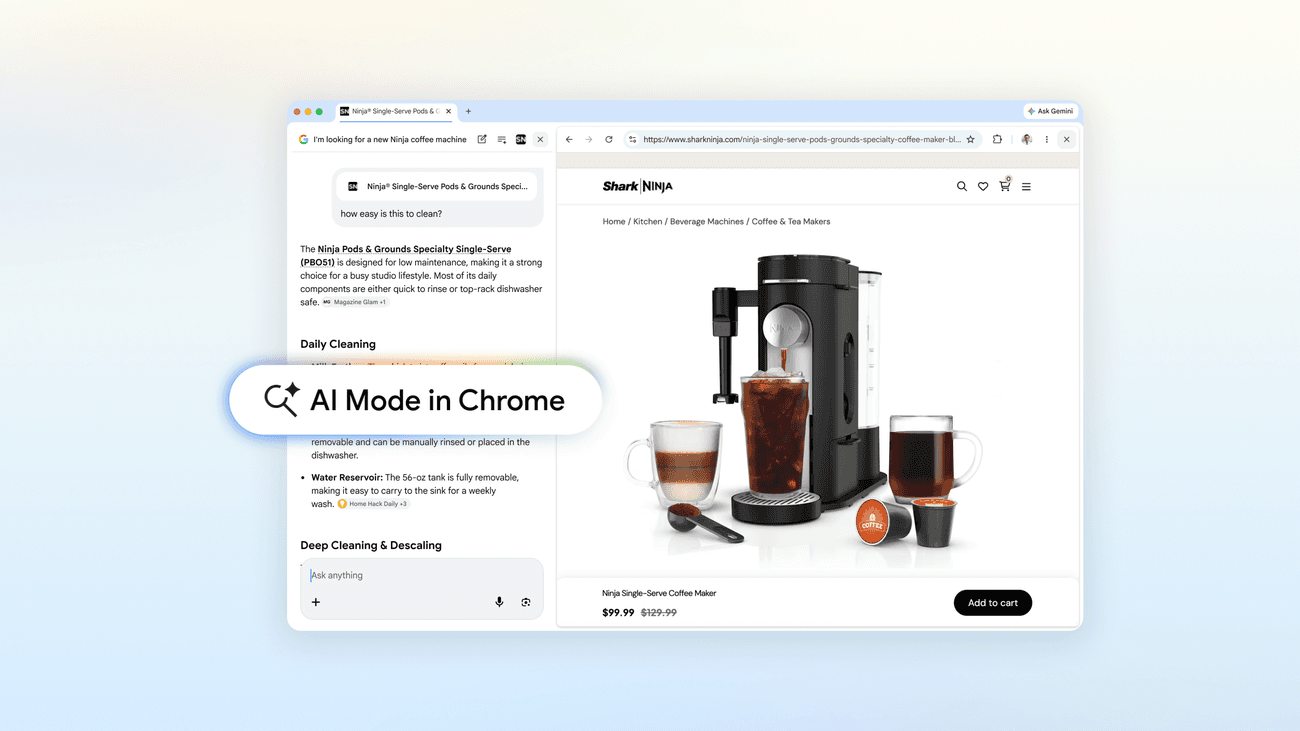
Google announced updates to AI Mode in the Chrome browser, describing changes to how users can query, summarize, and navigate web pages from within the browser interface. The company published the details in a post on its Keyword blog dated April 16, 2026.
What Google says is changing
According to the Keyword post, the update positions AI Mode as an integrated way to "explore the web" directly from Chrome, rather than through a separate Search surface. Google frames the rollout as upgrades to the existing AI Mode experience inside the browser, extending functionality that previously required users to visit Search.
The company's post describes AI Mode in Chrome as a feature that changes how users interact with web content, though the blog entry as published emphasizes the product framing over granular technical specifications. Google did not, in the portion of the post reviewed, publish a separate developer documentation link or API reference alongside the announcement.
DeepBrief has reached out to independent browser engineers and web standards analysts for comment on the integration's implications and will update this article if responses are received.
Context from prior AI Mode releases
AI Mode was introduced by Google as a conversational interface within Google Search, allowing multi-turn queries and synthesized answers drawn from web results. Bringing that surface into Chrome itself — as opposed to requiring a visit to google.com — represents a shift in where the feature lives in the user's workflow, according to the company's description.
Today's upgrades for AI Mode in Chrome transform how you interact with the web.
That line, drawn from the Keyword post's social share metadata, is Google's own characterization of the update.
Developer and integration questions
The Keyword post does not, in the reviewed content, specify whether the Chrome-integrated AI Mode exposes new extension APIs, affects existing Chrome extension permissions, or introduces changes for site operators regarding how their pages are read, summarized, or cited. It also does not detail rollout geography, Chrome channel availability (stable, beta, canary), or whether enterprise Chrome administrators can disable the feature via policy.
Google's post likewise does not indicate, in the reviewed material, changes to Chrome's handling of robots.txt, user-agent strings when AI Mode fetches page content on a user's behalf, or attribution mechanics for publishers whose pages are summarized.
DeepBrief has requested clarification from Google on each of these points. The company's press contact had not responded at the time of publication.
What the post does not address
The Keyword announcement, as reviewed, does not include self-reported benchmarks, latency figures, or model identifiers indicating which underlying Gemini variant powers AI Mode in Chrome. It does not disclose pricing tiers, usage caps, or whether the feature is limited to users signed into a Google account. It does not reference a public changelog entry in the Chromium project.
Because DeepBrief located no independent corroborating reporting or third-party technical analysis at the time of writing, details beyond Google's own framing remain unverified. The Keyword post is the sole primary source for this article.
Single-source caveat
Readers and developers evaluating whether to build against or around this feature should treat the functional descriptions above as Google's claims rather than independently confirmed behavior. DeepBrief will publish follow-up coverage if Chromium commit history, Chrome Enterprise release notes, or independent testing surfaces additional specifics about what AI Mode in Chrome does differently from the previous Search-hosted version.