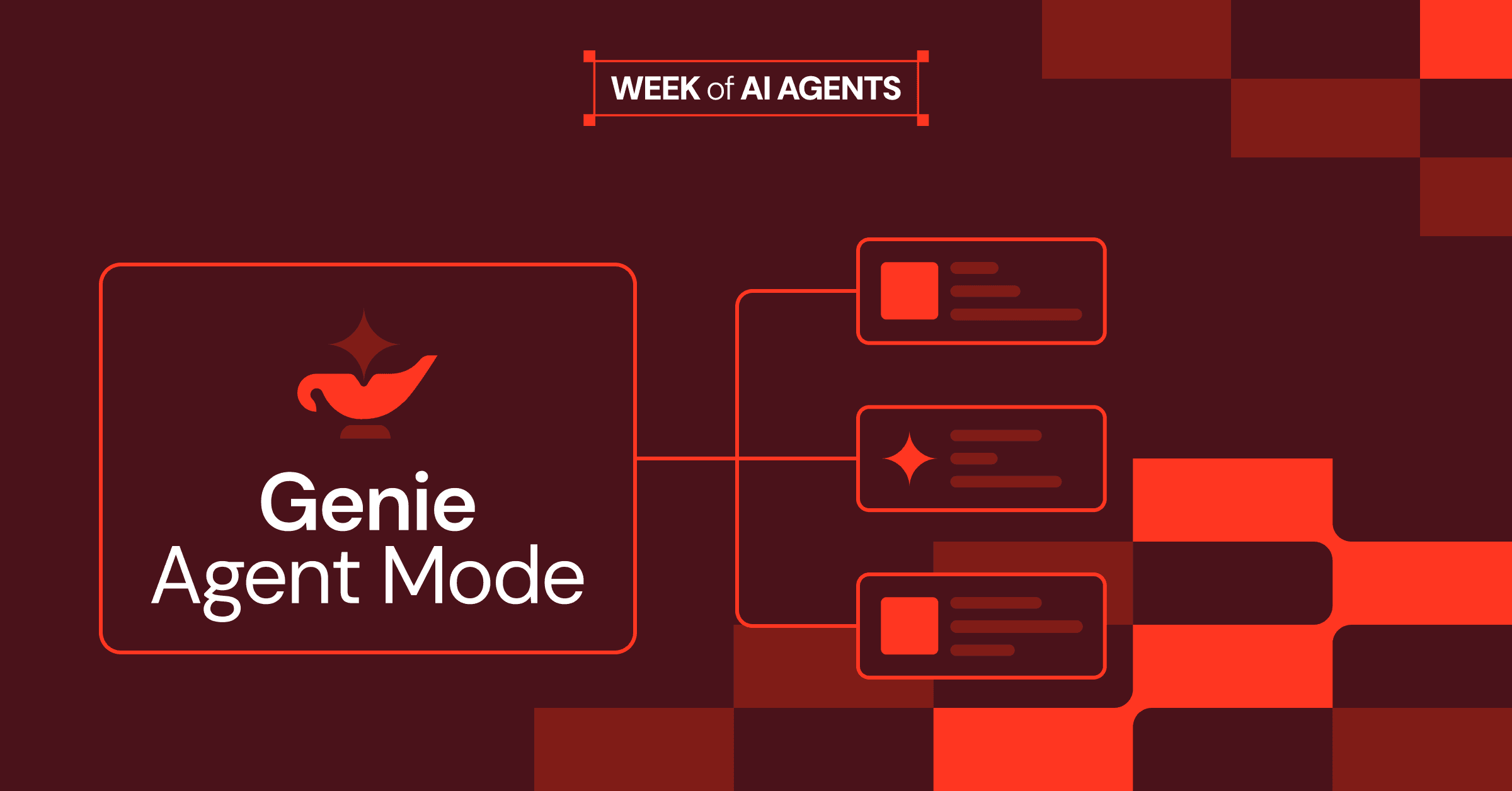
Databricks has introduced Agent Mode in its Genie spaces, according to a company blog post published on the Databricks website. The company describes the feature as an agentic capability layered into its existing Genie product, which lets business users query data using natural language.
What Databricks Says Agent Mode Does
According to the Databricks blog post, Agent Mode extends Genie beyond single-turn question answering into multi-step reasoning across a Genie space. The company states that the mode allows Genie to break a user request into a sequence of steps, execute queries, inspect intermediate results, and iterate toward an answer rather than returning a single generated SQL response.
Databricks says the agent operates within the governance boundaries of the underlying Genie space, meaning the tables, metrics, and instructions already configured by the space owner remain the scope of what the agent can access. The company frames this as a way to keep agentic behavior anchored to curated data context rather than arbitrary warehouse access.
The blog post indicates that Agent Mode is designed for questions that cannot be resolved with a single SQL statement, citing examples such as comparative analyses, root-cause investigations, and questions that require pulling from multiple tables in sequence.
Workflow Changes Inside Genie Spaces
Databricks reports that users toggle Agent Mode within an existing Genie space, and that the agent exposes its intermediate reasoning steps and the queries it runs as it works. The company says this step-by-step surface is intended to let analysts verify the path the agent took to an answer.
The agent operates within the governance boundaries of the underlying Genie space, according to Databricks.
For Genie space owners — typically data teams who configure tables, example queries, and instructions — Databricks says the existing configuration carries over to Agent Mode without separate setup. Instructions written for standard Genie behavior are used by the agent as guidance during multi-step execution, per the blog post.
The company states that the agent can revise its approach mid-task if an intermediate query returns unexpected results, re-planning subsequent steps based on what it observed. Databricks describes this as a shift from generating one SQL statement to orchestrating a sequence of them.
Availability and Integration Details
Databricks has not published pricing specific to Agent Mode in the blog post, and the company describes the capability as part of the Genie product surface rather than a separately licensed feature. The post does not specify a general availability date or regional rollout schedule beyond its announcement framing.
The blog post does not detail a dedicated public API for Agent Mode at launch, and Databricks has not committed to programmatic endpoints for invoking the agent outside the Genie UI in the published material. DeepBrief has reached out to Databricks for comment on API availability, rollout timing, and any usage limits, and will update this article if the company responds on the record.
Context on Genie and Agentic Analytics
Genie is Databricks' natural-language interface for querying data in a governed workspace, and the company has previously positioned it as a product for business users who do not write SQL. Agent Mode, per the blog post, is an addition to that existing product rather than a standalone offering.
The launch places Databricks alongside other data platform vendors that have added agent-style features to their analytics surfaces, including Snowflake with its Cortex Agents and Google Cloud with agent capabilities in BigQuery, based on prior announcements from those companies. DeepBrief has not independently compared the feature sets; readers should treat claims about relative capabilities as coming from each vendor's own documentation.
Databricks says in the blog post that Agent Mode is part of a broader effort to bring agentic patterns into its data intelligence platform, referencing the company's Mosaic AI and Agent Framework products as related building blocks. The post does not disclose which foundation models power Agent Mode or whether customers can configure the underlying model.
The blog post is attributed to the Databricks product team and was published on the Databricks company blog at databricks.com/blog/introducing-genie-agent-mode.