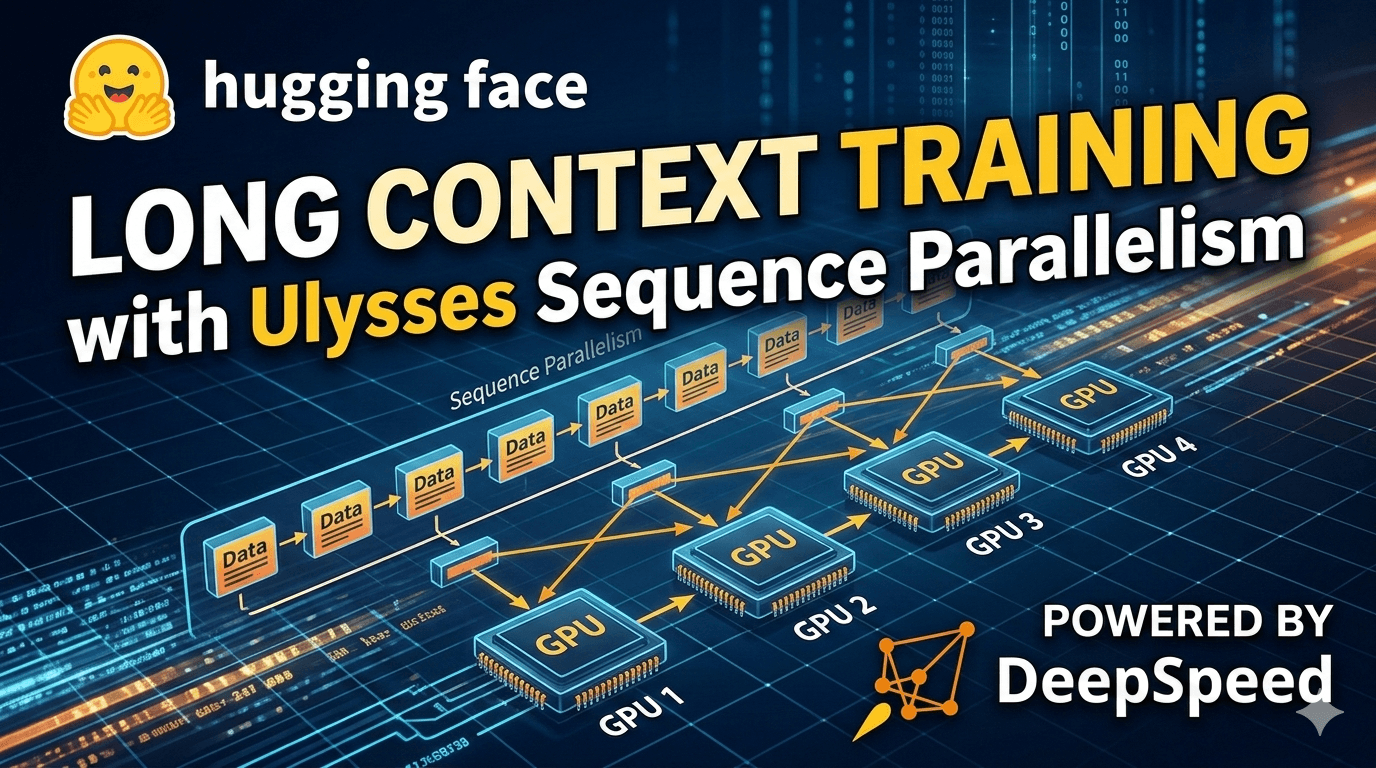
Hugging Face has published a detailed technical guide on Ulysses Sequence Parallelism, a distributed training method designed to enable large language models to handle contexts reaching one million tokens — a scale that standard single-GPU training cannot support.
Editor's Note: This article is based on an official announcement from the source organization. Claims regarding performance, benchmarks, and capabilities have not been independently verified.
Context length has become one of the defining constraints in modern AI development. Most training runs are limited not by model architecture but by GPU memory: the longer the input sequence, the more memory the attention mechanism consumes, scaling quadratically with sequence length. Ulysses Sequence Parallelism addresses this by distributing the sequence across multiple devices, allowing the combined memory of a GPU cluster to absorb what no single card could hold alone.
How Ulysses Splits the Work Across Devices
The core idea behind Ulysses Sequence Parallelism is straightforward: rather than processing an entire long sequence on one GPU, the sequence is partitioned into chunks and assigned to different devices. Each GPU handles its assigned segment of the sequence, and the devices communicate at the attention layer to exchange the key and value matrices needed to compute full attention across the whole context.
This communication step — an all-to-all collective operation — is what distinguishes Ulysses from simpler data parallelism approaches. Each GPU needs information from every other GPU's segment to correctly compute attention, so the devices must briefly share their intermediate representations before continuing.
The technique splits long sequences across multiple GPUs rather than fitting them onto a single device, directly addressing the memory bottleneck that has capped context length in large-scale training.
According to Hugging Face, the method integrates with existing distributed training frameworks and can be combined with other parallelism strategies such as tensor parallelism and pipeline parallelism, giving engineers flexibility in how they allocate compute resources.
Why Million-Token Contexts Matter for Real Applications
The push toward longer context windows is not purely academic. Practical applications increasingly demand models that can reason over entire documents, codebases, legal contracts, or scientific papers in a single pass. A model limited to a few thousand tokens must chunk and summarize long inputs, introducing errors and losing coherence. A model operating at one million tokens can, in principle, hold an entire novel or a large software repository in its working context simultaneously.
The medical, legal, and software engineering sectors have shown particular interest in long-context models. Summarizing lengthy clinical records, reviewing multi-document case files, or navigating a sprawling codebase all benefit directly from extended context. Several frontier labs — including Google, Anthropic, and OpenAI — have already released or announced models with context windows ranging from 128,000 to 2 million tokens, signalling that long-context capability is now a competitive differentiator.
Training those models efficiently, however, remains a significant engineering challenge. Ulysses Sequence Parallelism represents one approach to making that training tractable without requiring entirely new hardware.
The Engineering Trade-Offs
Sequence parallelism is not without costs. The all-to-all communication between GPUs introduces latency and bandwidth demands that can reduce hardware utilization if not carefully managed. The efficiency of the approach depends heavily on the interconnect speed between devices — high-bandwidth links such as NVLink within a single node or InfiniBand across nodes are typically required to keep communication overhead from dominating compute time.
Hugging Face's guide notes that Ulysses tends to perform well when the number of attention heads divides evenly across the participating GPUs, a constraint that affects how practitioners configure their training runs. Choosing the right parallelism strategy — and the right combination of strategies — requires balancing memory savings against communication costs for each specific model architecture and cluster configuration.
The technique was originally developed by researchers at Microsoft as part of the DeepSpeed library and has since been adopted and extended by the broader open-source training community. Hugging Face's documentation brings the method into its own ecosystem, making it more accessible to teams working with its training tools.
Open-Source Access and What Comes Next
By publishing this guide, Hugging Face is positioning its training stack as capable of supporting the long-context regimes that frontier research now demands. The documentation describes integration with the company's training infrastructure, lowering the barrier for teams that lack the specialized engineering resources of large AI labs.
The broader trajectory is clear: context length will continue to grow, and the infrastructure to support that growth must keep pace. Techniques like Ulysses Sequence Parallelism — alongside complementary advances in attention algorithms such as FlashAttention and ring attention — form the practical foundation that makes long-context training feasible at scale.
Whether open-source tooling can keep pace with proprietary infrastructure at the very frontier remains an open question, but publications like this one incrementally close the gap.
What This Means
For AI teams building or fine-tuning long-context models, Ulysses Sequence Parallelism — now documented within Hugging Face's ecosystem — offers a concrete, accessible path to training at context lengths that were practically out of reach without specialized in-house infrastructure.