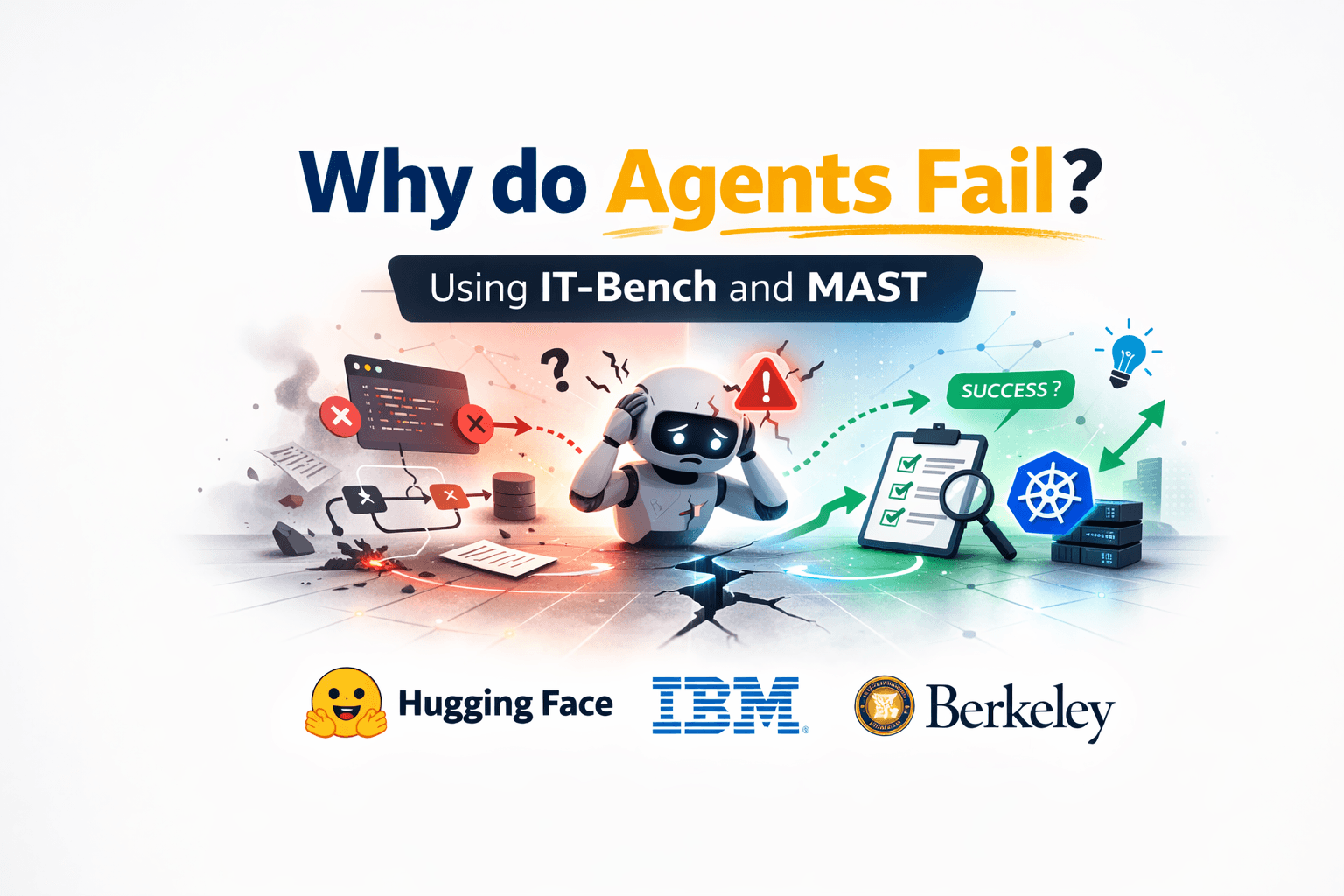
IBM Research and UC Berkeley have released IT-Bench and MAST, a paired benchmarking and failure-analysis framework aimed at pinpointing why AI agents underperform in enterprise IT settings, according to a post on the Hugging Face Blog.
Editor's Note: This article is based on an official announcement from the source organization. Claims regarding performance, benchmarks, and capabilities have not been independently verified.
Enterprise adoption of AI agents has accelerated, but deployment failures remain common and poorly understood. Most existing benchmarks tell operators whether an agent completed a task — they rarely explain where, why, or how it failed. IT-Bench and MAST are designed to close that diagnostic gap by providing both a standardized test environment and a taxonomy of failure causes specific to IT operations.
What IT-Bench Actually Tests
IT-Bench is a benchmarking suite built around realistic enterprise IT scenarios — the kind of multi-step, tool-dependent tasks that agents encounter in production: incident response, configuration management, system monitoring, and service restoration. Rather than abstract reasoning puzzles, the tasks reflect the messy, stateful environments where enterprise agents are expected to operate.
The benchmark is structured to capture not just whether an agent reaches the correct end state, but the quality and reliability of the steps it takes to get there. This matters because an agent that stumbles to the right answer through flawed reasoning may fail on a slight variation of the same task in production.
Most AI agent evaluations measure task success, but rarely explain the specific failure modes that prevent deployment at scale.
MAST: A Language for Agent Failures
MAST — the Multi-Agent System Taxonomy — provides the analytical layer on top of IT-Bench's results. It gives researchers and practitioners a structured vocabulary for categorizing the ways agents fail, moving beyond vague labels like "the model made an error" toward specific, actionable diagnoses.
Failure categories in MAST span a range of root causes: planning breakdowns, where an agent misunderstands task structure or sequences steps incorrectly; tool-use errors, where the agent calls the wrong function or misinterprets its output; context management failures, where relevant information drops out of the agent's working state across long task horizons; and grounding issues, where the agent's actions diverge from the actual system state it is supposed to be managing.
The taxonomy is intended to be reusable across different agent architectures, meaning teams can apply MAST analysis whether they are working with OpenAI's models, open-weight alternatives, or proprietary enterprise systems.
Why Diagnosis Matters More Than Scores
The distinction between scoring and diagnosis is not academic. An enterprise team that knows its agent achieves 62% task completion on IT-Bench has one useful data point. A team that knows the primary failure mode is context loss during multi-hop tasks — classified under MAST's context management category — has a roadmap for improvement.
This is the practical argument IBM and UC Berkeley make for the framework: benchmarks without taxonomies produce leaderboard numbers, not engineering insights. For IT operations specifically, where a failed agent action can mean a prolonged outage or a misconfigured system, understanding failure modes is a prerequisite for responsible deployment, not an optional refinement.
The research also implicitly challenges the way many organizations currently evaluate AI agents — through narrow demos and curated test cases that do not surface the edge cases and failure patterns that emerge under realistic operating conditions.
The Enterprise IT Context
IT operations represent one of the highest-value and highest-risk domains for AI agent deployment. Enterprises are actively investing in autonomous agents for tasks like alert triage, runbook execution, and infrastructure provisioning. The appeal is clear: skilled IT staff are expensive and scarce, and many operational tasks are repetitive and rule-bound.
But the same characteristics that make IT ops attractive for automation — complex toolchains, stateful environments, real consequences for errors — also make it a hard domain for current-generation agents. Failures are not just embarrassing; they can cascade into system-wide incidents.
IT-Bench addresses this by grounding evaluations in the actual tooling and task structures of enterprise IT, rather than generic agentic benchmarks that may not transfer to operational reality. The Hugging Face Blog post positions the release as an open resource for the research community, suggesting both the benchmark and taxonomy will be publicly available for external teams to use and build on.
What This Means
For teams building or evaluating AI agents for enterprise IT, IT-Bench and MAST provide the first structured framework for moving from benchmark scores to specific, fixable failure diagnoses — making responsible deployment decisions substantially more tractable.